introdection
In today’s world, trading is no longer just a side hustle—it has become a serious career option for many people. Along with this growth, a new concept called funded trading has gained massive popularity.
However, in India, there is still a lot of confusion around it. Many people ask questions like:
- Is funded trading legal in India?
- Why is it restricted?
- How is it different from normal trading?
In this blog, we will break everything down in a simple and clear way.
What is Funded Trading?

Funded trading is a model where a proprietary trading firm (prop firm) provides traders with capital to trade.
Instead of risking your own money:
- You pay a small fee to take an evaluation or challenge
- You follow certain rules set by the firm
- If you pass the challenge, you receive a funded account
- You trade using the firm’s capital and share the profits
Simple Example:
Imagine you get access to a $100,000 account.
If you make a profit of $10,000, you may keep 70%–90% of it depending on the firm.
This allows traders to scale without needing large personal capital.
Why is Funded Trading Restricted in India?
Funded trading is not officially “banned” in India, but it operates in a legal grey area. Here are the main reasons
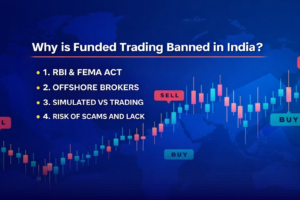
1. Forex Regulations (RBI & FEMA Act)
In India, trading is only allowed in specific currency pairs involving INR (like USD/INR).
However, most prop firms offer:
- EUR/USD
- GBP/USD
- Gold (XAUUSD)
- These instruments are not permitted under Indian forex regulations, which creates a conflict.
2. Use of Offshore Brokers
Most funded trading firms are based outside India and use offshore brokers.
This means:
- They are not regulated by Indian authorities
- Legal protection for Indian traders is limited
3. Simulated vs Real Trading Confusion
Many prop firms provide demo or simulated accounts rather than real market execution.
This creates confusion:
- Is the trading environment real?
- Are the profits actually generated from the market?
4. Risk of Scams and Lack of Regulation
Since this industry is not strictly regulated in India:
- Some firms may operate unethically
- There is a higher risk of fraud
The Reserve Bank of India (RBI) focuses on protecting retail traders, which is why such models are indirectly restricted.
Difference Between Trading and Funded Trading
Feature |
Regular Trading |
Funded Trading |
|
Capital |
Your own money |
Firm’s capital |
|
Risk |
Full personal risk |
Limited to challenge fee |
|
Profit |
You keep 100% |
Shared with firm |
|
Entry Barrier |
Requires higher capital |
Low entry cost |
|
Rules |
No restrictions |
Strict rules to follow |
Which One is Better?
It depends on your experience and goals.
For Beginners:
Funded trading can be a good option because:
- You don’t need large capital
- Risk is limited
- It helps you gain experience
For Experienced Traders:
Regular trading may be better because:
- You keep full profits
- You have complete freedom
- No external rules or restrictions
Conclusion
Funded trading is a powerful opportunity, especially for those who lack capital. However, in India, it operates in an unclear legal space.
Before getting involved, it is important to:
- Do proper research
- Choose reliable firms
- Understand all rules and risks
At the end of the day, success in trading depends on:
Skill, discipline, and strong risk management.